Water Softener Repair & Replacement in Garland, TX
Garland, TX Water Softener Service for Hard Water, Scale, Leaks & System Failures
When you need water softener repair Garland TX homeowners can rely on, the problem is usually already noticeable: white crust around faucets, spotty dishes, cloudy shower glass, a brine tank full of water, a system that is not using salt, or hard water that has suddenly returned. Center Garland Plumbing provides diagnosis, repair, maintenance, replacement, and installation support for residential and commercial water-softener systems throughout Garland and nearby North Texas communities.
Garland's municipal water is classified as hard, averaging about 161 mg/L, or approximately 7.0–10.5 grains per gallon. A home-specific water test and system inspection help determine whether your current softener needs adjustment, repair, resin/media service, or replacement.
📞 Call Now for Water Softener ServiceCall +1 (945) 387-1123 to schedule water softener diagnosis in Garland, TX.
- Water softener not using salt or not regenerating
- Brine tank full of water, overflowing, or not refilling
- Hard water returning, white spots, scale, cloudy glass
- Leaks, damaged fittings, and drain-line issues
- 24/7 support for active leaks & overflows
Request Water Softener Service
Fill out the form and a licensed Garland plumber will contact you promptly.
Water Softener Repair Garland TX Backed by Experienced Plumbing Professionals
A Clear, Practical Approach to Hard Water and Failing Softener Systems
A water softener should reduce the mineral-related problems that make cleaning harder and contribute to buildup around fixtures and appliances. When the unit stops using salt, keeps cycling, starts leaking, fills with excess water, loses pressure, or no longer softens the water, you need answers before spending money on a replacement.
Center Garland Plumbing approaches water-softener service with a diagnosis-first process. We inspect the visible equipment, plumbing connections, bypass position, drain setup, brine components, valve operation, and treated-water performance before explaining the available options. Some issues are simple and repairable; others indicate that the system is aging, incorrectly sized, damaged, or no longer a good candidate for continued repair.
Residential & Commercial
Plumbing support for residential and commercial water-treatment equipment.
Practical Troubleshooting
Hard water, brine, salt, drain, and control-valve issue diagnosis in plain language.
Repair-vs-Replacement
Clear, honest recommendations before major work or replacement is proposed.
Urgent Leak Support
Available support for leaks, overflows, and water-damage risks.
Water Softener Repair Near Firewheel, Duck Creek, Club Hill & Garland Neighborhoods
Serving Homes and Businesses Throughout Garland's Established Neighborhoods and Growing Communities
Whether you are near Firewheel Town Center, Historic Downtown Garland, Duck Creek Park, Spring Creek Forest Preserve, Lake Ray Hubbard, or one of Garland's established residential neighborhoods, hard-water symptoms can show up in daily routines. Mineral spotting on dishes, white buildup on faucets, stiff laundry, a cloudy shower door, or a water heater that accumulates scale may point to water hardness or a softener that is no longer performing correctly.
Center Garland Plumbing serves customers across North Garland, central Garland, and east Garland, including properties near Firewheel, Duck Creek, Buckingham, Centerville, Club Hill, Eastern Hills, Rose Hill, Spring Park, and Valley Creek. We also assist customers in nearby communities including Rowlett, Sachse, Wylie, Richardson, Plano, Mesquite, and Dallas.
Garland Neighborhoods We Serve
Nearby Cities & Communities
Local Landmarks & Hubs
- Firewheel Town Center
- Historic Downtown Garland
- Downtown Garland Square
- Duck Creek Park
- Spring Creek Forest Preserve
- Lake Ray Hubbard
- Firewheel Golf Park
- Garland Landmark Museum
Specialized Water Softener Repair & Replacement for Garland Properties
Accurate Diagnosis for Brine Systems, Control Valves, Resin Media, Bypass Valves & Plumbing Connections
A water softener is more than a salt tank. It is a connected treatment system that may include a mineral/resin tank, brine tank, control head, timer or meter, drain line, bypass valve, water connections, safety float, injector or venturi, and programmed regeneration settings. A problem in one component can make the whole system appear to have failed.
For example, a water softener not using salt may have a salt bridge, salt mushing, a clogged injector or venturi, a brine-line restriction, an incorrect regeneration setting, or a mechanical control-valve issue. A softener that is full of water may have a failed float, drain-line restriction, brine refill issue, or valve problem. A proper inspection helps separate a manageable repair from a replacement decision.
Texas also regulates water-treatment work. Depending on the work performed and applicable exemptions, persons who install, connect, maintain, service, or analyze water-treatment equipment may need an appropriate Texas State Board of Plumbing Examiners license or a Texas Commission on Environmental Quality Water Treatment Specialist license.
Brine Tank Inspection
Inspection of brine tanks, salt condition, floats, injectors, venturis, and brine lines.
Control Head Diagnosis
Troubleshooting of control heads, meters, timers, valves, pistons, seals, and settings.
Leak & Flow Diagnosis
Diagnosis of low flow, leaks, continuous draining, and regeneration failures.
Bypass & Plumbing Review
Review of bypass valves, plumbing connections, drain routes, and equipment placement.
What Happens When a Water Softener Fails in Garland?
Hard Water Can Return Quickly When a Softener Stops Regenerating, Drawing Brine, or Treating Water Properly
Hard water contains minerals such as calcium and magnesium. A conventional salt-based softener uses resin media to exchange hardness minerals from the incoming water. During regeneration — often called "regen" — the system uses brine to recharge the resin so it can continue treating water.
If the softener does not regenerate correctly, cannot draw brine, has depleted or damaged resin, is stuck in bypass, leaks, or is incorrectly programmed, hard water can return. Homeowners often first notice the problem through white spots on dishes, mineral scale around fixtures, soap that does not lather well, dry-feeling skin, rough hair, cloudy shower doors, stiff laundry, or a water heater that is scaling up.
Common Water-Softener Problems Include:
- Salt level not going down because of a salt bridge, salt mushing, or failed brine draw
- Water sitting too high in the brine tank or an overflow condition
- Water still feeling hard after regeneration
- A softener that keeps running, drains constantly, or gets stuck in regeneration
- Leaks at fittings, tanks, valves, seals, drain lines, or plumbing connections
- Low water pressure caused by restrictions, clogged components, or aging equipment
- Blank display, programming loss, power interruption, meter failure, or control-head issues
- Resin beads or media appearing in faucets, toilets, tubs, or appliance screens
- A system that is too small for the household's water use and hardness level
Prevent Water Softener Problems with Regular Maintenance in Garland
Simple Maintenance Helps Identify Salt, Brine, Valve, Resin & Programming Problems Before They Become Larger Repairs
A water softener does not need to be replaced every time it performs poorly. Routine attention can reveal a developing issue before hard water returns throughout the home or a leak causes property damage. The right maintenance schedule depends on your system type, water use, salt use, incoming water hardness, unit age, and the condition of the equipment.
A professional maintenance visit can include a hardness check, salt and brine inspection, review of regeneration settings, valve and drain-line assessment, leak inspection, and discussion of whether the existing system remains suitable for the property.
| Maintenance Task | What It Involves | Why It Matters |
|---|---|---|
| Salt & Brine Inspection | Check salt condition, bridging, mushing, water level, and brine components | Helps identify why the system may not be using salt |
| Water-Hardness Testing | Compare incoming and treated water performance | Helps confirm whether the unit is still softening effectively |
| Bypass & Plumbing Check | Inspect bypass position, fittings, valves, and visible connections | Identifies flow restrictions, leaks, or accidental bypassing |
| Regeneration Review | Review settings, meter/timer operation, and cycle behavior | Helps prevent hard-water breakthrough or excessive regeneration |
| Injector & Venturi Assessment | Inspect brine-draw components when appropriate | Helps diagnose poor brine draw and salt-use problems |
| Drain-Line Inspection | Check for kinks, clogs, or poor routing | Helps reduce overflow and continuous-drain concerns |
| Repair/Replacement Guidance | Explain realistic options after diagnosis | Supports informed decisions without unnecessary replacement |
Simple Owner Checks to Keep in Mind:
- Check your salt level regularly rather than waiting for the system to stop working
- Keep the area around the unit accessible for service and leak checks
- Address a puddle, dripping fitting, unusual noise, or continuous drain discharge promptly
- Schedule a diagnostic visit if hard water returns, spots increase, or the system stops using salt
- Keep product manuals and past repair information when available
Who Needs Water Softener Repair or Replacement in Garland?
Water-Softener Problems Affect Homes, Rental Properties, Offices, Restaurants & Multi-Unit Buildings
Water-softener service is not limited to single-family homes. Any property using a whole-home, point-of-entry, commercial, or multi-unit water-treatment system may need professional repair, programming, maintenance, or replacement when hard-water symptoms return or equipment begins to fail.
Single-family homes with salt-based or whole-home water softeners
Townhomes, condos, rental homes, and property-management portfolios
Apartment communities and HOAs with common-area or multi-unit systems
Restaurants, cafes, commercial kitchens, and food-service facilities
Offices, retail spaces, salons, gyms, and hospitality properties
Medical offices, clinics, dental facilities, and specialty commercial spaces
Warehouses, industrial properties, and facilities with water-treatment equipment
Businesses that need reliable water quality for fixtures, appliances, staff areas, or operations
How Garland Water Conditions and Household Use Affect Water Softener Performance
Hardness, High Water Demand, Seasonal Use & Equipment Age Can Change How a Softener Performs
Garland Water Utilities states that the city's water is considered hard and that hardness fluctuates, averaging about 161 mg/L or 7.0–10.5 grains per gallon. This level of hardness can contribute to scale on fixtures and appliances if a water softener is undersized, poorly maintained, incorrectly programmed, bypassed, or no longer operating effectively.
The best water-softener setting and size are not determined by city averages alone. A property's actual water demand, household size, plumbing layout, appliance use, peak demand, and on-site hardness test all matter.
Summer
Higher water use, irrigation, guests, laundry, and bathing demand can expose a system that regenerates too infrequently or lacks capacity.
Winter
Freezing conditions can affect equipment located in garages, exterior closets, or unprotected spaces.
Spring & Fall
Seasonal home maintenance often reveals scale buildup, reduced flow, and softener performance issues.
Year-Round
High demand from larger families, rental turnover, or commercial use can make an undersized system regenerate too often or allow hard water to break through.
Common Water Softener Types Used in Garland, TX
Understanding the System Treating Water in Your Home or Business
Different water-treatment systems operate in different ways. Some use salt and resin to soften water, while others are conditioners, filtration systems, or combination units designed to address multiple water concerns. Correct diagnosis begins with identifying the equipment type, its condition, and what it is intended to do.
| System Type | Typical Use | How It Works | Service Considerations |
|---|---|---|---|
| Salt-Based Ion-Exchange Softener | Whole-home hard-water reduction | Uses resin media and salt brine to remove calcium and magnesium | Requires salt, regeneration, drain connection, and working control valve |
| Single-Tank Softener | Many standard homes | One resin tank alternates between service and regeneration | May provide untreated water during regeneration depending on design |
| Twin-Tank Softener | Higher-demand homes or continuous-use applications | Alternates tanks to maintain treated water availability | Requires correct programming, plumbing setup, and capacity planning |
| Demand-Initiated System | Homes seeking efficiency | Regenerates based on measured water use | Meter, settings, valve operation, and water-hardness programming matter |
| Timer-Based System | Older residential systems | Regenerates on a fixed schedule | May waste salt/water or fail to keep up with household demand |
| Softener + Filter Combination | Homes addressing hardness plus sediment, taste, or odor | Combines water treatment stages | Needs coordinated maintenance and accurate diagnosis |
| Salt-Free Conditioner | Scale-management applications | Does not soften water through ion exchange | Requires clear expectations because it does not operate like a salt-based softener |
Reliable performance depends on correct installation, accurate settings, proper drain routing, suitable equipment sizing, regular inspection, and maintenance that addresses problems before they spread through the plumbing system. If your property also needs sediment, taste, or odor treatment, ask about our water filtration repair & replacement service.
Our 6-Step Water Softener Repair Process
What to Expect When Center Garland Plumbing Evaluates Your System
Initial Call & Symptom Review
We discuss what you are noticing: salt not going down, hard water returning, a brine tank full of water, continuous draining, a leak, low pressure, scale, resin beads, or an aging system.
On-Site Equipment & Plumbing Inspection
We inspect the visible softener components, brine tank, resin tank, control head, bypass valve, drain arrangement, plumbing connections, and accessible signs of leaks or restrictions.
Water Testing & Performance Check
We evaluate incoming and treated water conditions as appropriate and review whether the system is providing the hardness reduction expected for your property.
Brine, Regeneration & Control-System Diagnosis
We examine likely causes such as salt bridges, salt mushing, brine-line restrictions, injector/venturi issues, float concerns, meter/timer problems, valve faults, or programming errors.
Repair or Replacement Options
We explain whether the issue is practical to repair, whether resin/media service may help, or whether the equipment is damaged, obsolete, undersized, or better suited for replacement.
Service Completion & System Guidance
After approved work, we explain the repair or replacement, discuss basic salt and maintenance practices, and answer questions about operation, regeneration, bypass use, and warning signs to watch for.
What's Included in Our Water Softener Service
Clear Findings and Practical Next Steps for Garland Property Owners
Every water-softener issue is different. A unit that is not using salt may need a simple salt-bridge correction, while a leaking or repeatedly failing system may require more involved repair or a replacement discussion. Center Garland Plumbing explains the scope of the visit based on the actual condition of your equipment.
- Review of your symptoms, water use, and equipment history
- Visual inspection of the softener, brine tank, control head, valves, and connections
- Check of salt condition, salt bridge risk, salt mushing, and brine-tank water level
- Water-hardness or treated-water performance assessment when appropriate
- Inspection of bypass position, visible plumbing, drain line, and accessible fittings
- Diagnosis of regeneration, timer, meter, motor, valve, or brine-draw concerns
- Leak and flow assessment for visible water or pressure issues
- Clear explanation of repair options and replacement triggers
- Written estimate or scope explanation for approved work
Key Advantages of Working with Center Garland Plumbing
Diagnosis First, Clear Options Second
Water-softener problems can be frustrating because the symptoms often appear far from the equipment itself. You may notice scale on a faucet, residue in a dishwasher, spotting on shower doors, a strange taste after regeneration, or low flow at a fixture before you ever look at the softener. Our approach focuses on identifying the cause, not just treating the visible symptom.
Whole-System Inspection
Whole-system inspection instead of guessing from one symptom.
Water Testing
Hard-water and treated-water performance evaluation when appropriate.
Common Repairs
Repair options for common brine, valve, injector, drain, bypass, and plumbing issues.
Replacement Planning
Replacement planning based on household demand, water hardness, equipment condition, and installation needs.
Plain Language
Straightforward explanations in clear, practical language.
Related Plumbing Support
Support when scale affects fixtures, water heaters, or water lines.
Water Softener Repair & Replacement Outcomes for Garland Properties
What Can Change After the Right Diagnosis and Service
A water-softener repair or replacement should provide a clear improvement in system reliability and help reduce hard-water symptoms where the equipment is properly selected, installed, programmed, and maintained. Results vary by system condition, water chemistry, household use, and related plumbing issues, but the goal is always to identify the actual cause before recommending work.
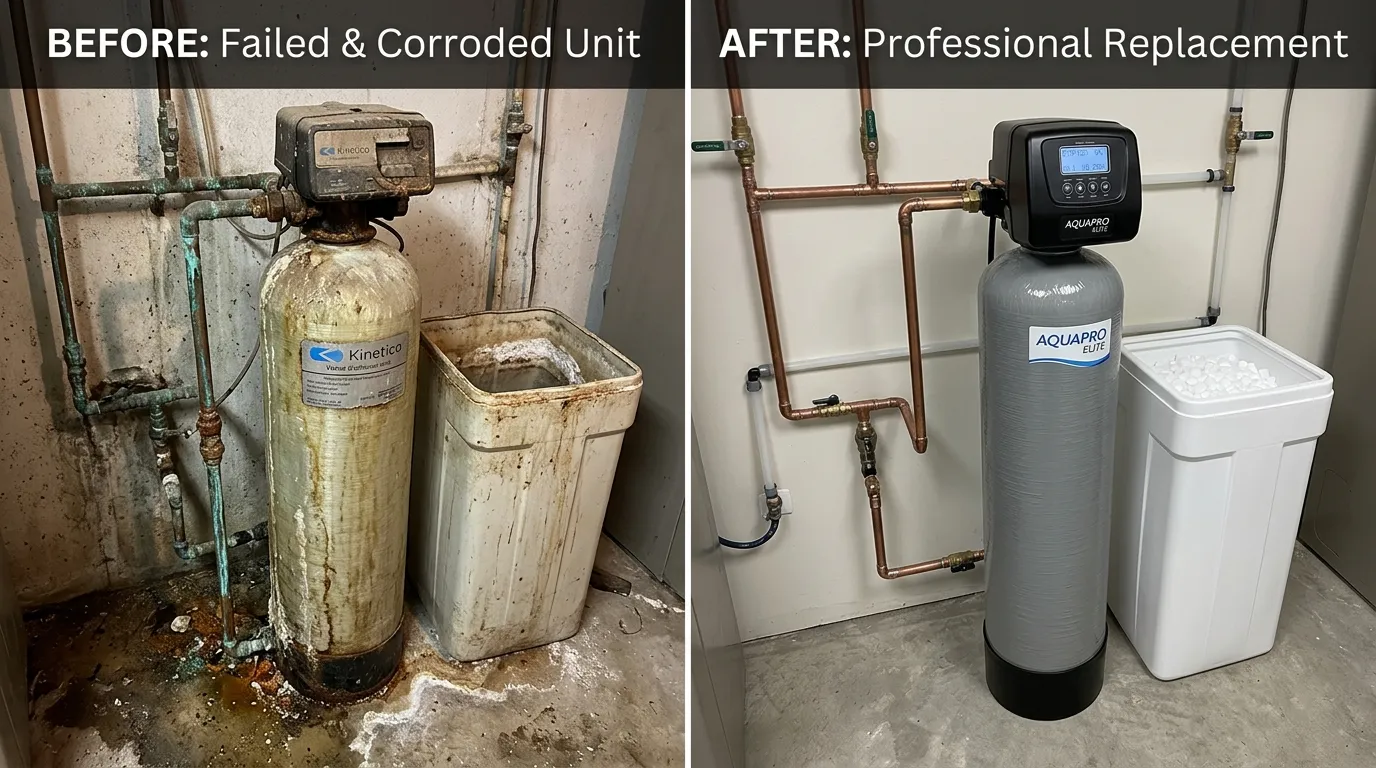
- Salt appears full but never goes down
- Dishes, shower glass, and fixtures increasingly spotted or crusted with mineral scale
- Brine tank contains too much water, unit leaks, or the drain runs continuously
- Aging unit has repeated issues and uncertain capacity
- Underlying bridge, brine-draw, or regeneration issue identified and addressed where repairable
- Treated-water performance evaluated, and settings, repairs, or replacement options explained
- Source of the issue assessed with practical safety, repair, or replacement guidance
- Right-sized replacement recommendation based on actual needs rather than a generic estimate
How We Repair, Replace & Install Water Softener Systems
Proper Water Treatment Requires Correct Equipment, Plumbing Connections, Drainage & Setup
A water-softener installation or replacement must work with the home's water line, bypass arrangement, drain location, pressure conditions, and available space. It should also be selected for the household's actual hardness level and water usage — not simply installed based on a generic grain rating.
- Water-softener equipment sized for household occupancy, water use, and tested hardness
- Properly accessible bypass valves and service connections
- Secure plumbing connections and leak-resistant fittings
- Appropriate drain routing and air-gap or approved drainage considerations where applicable
- Brine tank placement that allows access for salt filling and inspection
- Review of electrical needs for systems with powered controls
- Coordination with water-filtration equipment when the home has additional treatment needs
- Start-up, settings review, and basic operation guidance after installation or replacement
Should You Repair or Replace a Water Softener in Garland?
The Right Choice Depends on the Failure, Age, Parts Availability, Capacity & Overall Condition
A repair can be the sensible choice when a specific, serviceable component has failed and the rest of the system remains in good condition. Replacement may be the better value when damage is extensive, parts are unavailable, the unit repeatedly fails, the equipment is outdated, or the system cannot keep up with the property's water demand.
| Situation | Repair May Be Appropriate | Replacement May Be More Practical |
|---|---|---|
| Salt Bridge or Salt Mushing | Yes, when the system is otherwise operating correctly | Usually not necessary |
| Clogged Injector, Venturi, Screen, or Brine Line | Often repairable after inspection | Consider only if larger system issues exist |
| Minor Fitting, Seal, or Plumbing Leak | Often repairable | Usually unnecessary unless equipment is severely aged or damaged |
| Control-Valve, Timer, Meter, Motor, or Piston Issue | Depends on repair cost, model age, and parts availability | May be better for obsolete or repeatedly failing systems |
| Resin/Media Issue | Media service may be possible in some systems | Consider when tank, control head, and media are all near end-of-life |
| Cracked Tank or Damaged Cabinet | Usually not a dependable long-term repair | Often the safer and more practical option |
| System Too Small for Household Demand | Settings may help in limited cases | A properly sized replacement may be needed |
| Repeated Hard-Water Breakthrough & Expensive Repairs | Short-term repairs may be possible | Replacement can provide better long-term value |
Water Softener Replacement Cost Garland TX and Repair Cost Factors
Clear Estimates Begin with an Accurate Diagnosis
The cost of water-softener repair or replacement depends on the equipment, the cause of the problem, access, installation layout, required parts, and whether the system can be restored reliably. A system that needs a minor adjustment or brine component repair will have different cost considerations from a replacement involving new equipment, plumbing modifications, drain work, filtration integration, or capacity upgrades.
| Service Type | Main Cost Considerations |
|---|---|
| Water-Softener Diagnosis | Symptoms, access, testing needs, and condition of existing equipment |
| Salt, Brine, or Injector Repair | Salt bridge, float, brine line, injector, venturi, or screen condition |
| Control-Valve Repair | Brand/model, motor, seals, piston, timer, meter, and parts availability |
| Leak Repair | Location of leak, fittings, valves, tanks, plumbing connections, and water damage risk |
| Resin/Media Service | Tank condition, media type, labor access, and overall equipment age |
| Full Water-Softener Replacement | System capacity, water hardness, household demand, plumbing layout, drain setup, and installation requirements |
| Commercial or Multi-Unit Service | Number of systems, size, access, scheduling, water demand, and property coordination |
Before approving work, ask for an explanation of the diagnosis, the repair scope, and whether replacement would offer a meaningful long-term benefit.
When Should Garland Property Owners Call for Water Softener Repair?
Common Signs That a System Needs Diagnosis, Maintenance, Repair or Replacement
You do not have to wait for a complete softener failure to ask for help. Call Center Garland Plumbing when you notice a sudden change in water quality, salt use, water pressure, system behavior, or visible leaks.
- Your water softener is not using salt
- The salt level has not changed for months
- There is too much water in the brine tank
- The brine tank is overflowing or has an unusual odor
- The system is stuck in regeneration or keeps running
- Water is constantly draining from the unit
- The water softener is leaking in the garage, utility room, closet, or mechanical area
- Hard water, white spots, scale, or rough laundry have returned
- Your water feels hard again after the system regenerates
- You have low water pressure after the softener or possible restrictions
- You find resin beads, yellow beads, clear beads, or sand-like material in fixtures
- Your water tastes unusually salty after regeneration
- Your household has grown and the system may no longer have enough capacity
- You are tired of repeated repairs on an older unit
Commercial Water Softener Repair & Replacement in Garland, TX
Water Treatment Support for Businesses, Multi-Unit Properties, HOAs & Facility Managers
Commercial plumbing and water-treatment needs can be different from residential service. A business, apartment community, restaurant, office building, salon, healthcare facility, or multi-unit property may have larger equipment, higher water demand, multiple treatment stages, restricted service access, or maintenance needs that require coordination with a manager or facilities team.
Center Garland Plumbing provides commercial water-softener service planning for Garland-area properties that need help diagnosing hard-water symptoms, evaluating equipment condition, repairing components, improving system capacity, or replacing outdated units.
| Commercial Service | Description |
|---|---|
| System Assessment | Review visible water-treatment equipment, symptoms, demand, and access requirements |
| Repair Service | Diagnose brine, valve, injector, drain, meter, fitting, leak, and control concerns |
| Replacement Planning | Recommend properly sized equipment for water use, space, access, and installation needs |
| Multi-Unit Coordination | Plan service windows for apartments, HOAs, offices, retail properties, and larger sites |
| Related Commercial Plumbing | Coordinate work with water lines, fixtures, water heaters, filtration, and building plumbing needs |
Commercial Properties That May Benefit:
- Restaurants, cafes, bars, and commercial kitchens
- Hotels, hospitality properties, and event venues
- Apartment communities, condominiums, and HOA-managed buildings
- Office parks, retail centers, salons, and fitness facilities
- Medical offices, dental practices, and clinics
- Warehouses, industrial sites, and logistics facilities
- Schools, churches, and community buildings
Benefits of Hiring Water Softener Repair Professionals in Garland
Better Diagnosis, Safer Repairs & More Confident Replacement Decisions
A water softener can look simple from the outside, but problems inside the brine system, resin tank, control valve, drain line, or plumbing connections may not be obvious. Professional service helps you avoid replacing a unit that may be repairable — or repeatedly repairing a unit that is no longer dependable or correctly sized.
- Identify why hard water is returning instead of treating symptoms alone
- Find salt bridges, brine problems, clogged injectors, or bypass issues
- Reduce the risk of leaks, overflows, continuous drainage, and water damage
- Evaluate pressure and flow concerns related to the softener or connected plumbing
- Protect fixtures, dishwashers, water heaters, and appliances from ongoing scale buildup
- Choose a system size based on actual water hardness and property demand
- Understand the difference between a salt-based softener and a salt-free conditioner
- Receive clear repair and replacement options before major work begins
Why DIY Water Softener Repairs Can Create Bigger Problems
Avoid Forced Valves, Pressurized Disassembly, Electrical Risks & Uncontrolled Leaks
Some homeowner maintenance tasks, such as monitoring salt levels or recognizing a likely salt bridge, can be simple. However, internal valve work, pressurized plumbing connections, electrical controls, drain modifications, resin-tank work, and leak repairs can create damage or unsafe conditions if handled incorrectly.
Do not force a bypass valve, dismantle a pressurized system, mix cleaners or chemicals, or ignore a continuous leak or overflow. If the softener is actively leaking and you know how to safely use the bypass, placing the unit in bypass can stop treated-water flow through the system while you arrange service. If water is near electrical components, is pooling heavily, or cannot be controlled, seek prompt professional assistance.
Risks of DIY Water Softener Repair:
- Incorrect repairs can cause leaks, poor performance, overflow, or water damage
- A forced valve or fitting can crack plastic components or damage plumbing connections
- Improper drain routing can cause discharge or overflow problems
- Wrong programming may cause excess salt/water use or allow hard-water breakthrough
- Damaged resin tanks and failed media may require professional assessment
Texas water-treatment work may require appropriately licensed professionals depending on the service performed.
Answers to Common Water Softener Questions in Garland, TX
Clear Answers for Hard Water, Salt, Brine, Regeneration, Leaks & Replacement
Why is my water softener not using salt?
A water softener may stop using salt because of a salt bridge, salt mushing, clogged injector or venturi, brine-line issue, float problem, failed regeneration cycle, bypass setting, or control-valve malfunction. If salt remains at the same level for a long time and hard water returns, the system should be inspected.
Why is there water in my water softener's brine tank?
Some water in the brine tank may be normal, depending on the system and stage of operation. However, unusually high water, an overflow, recurring refill problems, or failure to draw brine can indicate a float, drain, injector, brine-line, or control-valve issue. If the water level keeps rising, schedule service.
Why is my water softener still producing hard water?
Hard water may return if the softener is bypassed, out of salt, bridged with hardened salt, not regenerating, programmed incorrectly, undersized, unable to draw brine, or experiencing resin/media or valve problems. A treated-water test helps determine whether the issue is a setting, repair, capacity, or replacement concern.
Can a salt bridge stop a water softener from working?
Yes. A salt bridge is a hardened crust of salt that forms above the water level in the brine tank. It can make the tank look full even though the water below cannot dissolve enough salt to create brine. A careful check may confirm the issue, but do not strike plastic tank components aggressively.
Why is my water softener stuck in regeneration?
A system may become stuck in regeneration because of a control-valve, motor, timer, piston, seal, debris, meter, or programming issue. A softener that runs continuously, drains nonstop, or fails to complete a cycle should be professionally diagnosed to avoid wasted water, excess salt use, or hard-water breakthrough.
Why is my water softener draining continuously?
Continuous discharge can be caused by a valve that is stuck in a cycle, damaged internal components, a control issue, or a drain-related problem. Turn to a professional promptly if the unit is wasting water, flooding, or draining continuously.
Why is my water softener leaking?
Leaks may come from plumbing fittings, bypass valves, seals, control heads, brine tanks, resin tanks, drain lines, or damaged components. If water is pooling, spraying, approaching electrical equipment, or causing damage, call for prompt service. If it is safe and you understand your equipment, bypassing the softener can help limit flow through the unit until it is inspected.
Can a water softener cause low water pressure?
A water softener may contribute to low flow if there is a restriction in the control valve, resin tank, plumbing connection, bypass arrangement, or related piping. Low pressure can also come from other plumbing problems. Comparing water flow in service mode and bypass mode can help a professional narrow down the cause.
What are the little beads coming out of my faucet?
Small amber, yellow, clear, or sand-like beads may be resin media from a damaged water softener. This can happen when internal media retention components fail or the resin tank/system has a significant problem. Stop using the softener in service mode if possible, use the bypass when safe, and arrange service to protect fixtures and plumbing screens.
Should I repair or replace my water softener?
Repair may be worthwhile for a specific, serviceable issue such as a salt bridge, injector problem, minor leak, float issue, or replaceable valve part. Replacement may be more practical for cracked tanks, unavailable parts, repeated failures, badly degraded media, poor sizing, or outdated equipment. A diagnosis should come before a major purchase.
How long does a water softener usually last?
A water softener's life varies by water chemistry, use, maintenance, installation quality, resin condition, control-valve wear, model, and parts availability. Do not replace a unit solely because of age; assess its condition, repair history, performance, and whether it meets current demand.
What size water softener does my Garland home need?
The right size depends on tested hardness, household size, number of bathrooms, daily water use, peak demand, appliances, plumbing layout, and how often the system should regenerate. Garland's average water-hardness figure can be a starting reference, but an on-site test and household-use review are more reliable for sizing.
Does Garland have hard water?
Yes. Garland Water Utilities says the city's water is considered hard, with hardness levels that vary monthly and average approximately 161 mg/L, or 7.0–10.5 grains per gallon.
Is hard water unsafe to drink?
Hard water is not automatically unsafe. Garland Water Utilities states that hardness does not affect water safety. Hardness is mainly associated with calcium and magnesium minerals and can contribute to scale, spotting, cleaning difficulty, and appliance buildup.
Can I bypass my water softener until it is repaired?
If there is an active leak, overflow, or serious system issue, using the bypass may help stop treated-water flow through the unit if you know how to operate it safely. Water entering the home may be untreated while the system is bypassed. Do not force a valve; call for assistance if you are unsure.
Do I need a plumber or a water-treatment technician for water softener repair?
The right professional depends on the work needed. Water-treatment equipment service may require an appropriately licensed plumber or Texas Water Treatment Specialist, depending on the activity and applicable exemptions. Choose a provider who can evaluate both the treatment equipment and its plumbing connections.
How often should I add salt to a water softener?
Salt use varies by household demand, incoming hardness, unit size, regeneration settings, and system efficiency. Check the salt level regularly and add the type of salt recommended for your specific equipment. If the salt level never decreases, the system may have a salt bridge or brine-draw problem.
Why does my water taste salty after regeneration?
A salty taste may indicate that the system did not rinse properly, has a regeneration or valve issue, is programmed incorrectly, or needs inspection. Do not ignore recurring salty water; schedule a diagnosis.
Why are my dishes still spotty with a water softener?
Spotty dishes can occur when the softener is not treating water effectively, is bypassed, needs adjustment, has exhausted capacity, is not regenerating properly, or when dishwasher settings and rinse-aid use need review. Testing treated water helps identify whether the softener is the main cause.
Can hard water damage my water heater or tankless water heater?
Hard water can contribute to mineral-scale buildup inside conventional and tankless water-heating equipment. Over time, scale can affect heat transfer, efficiency, flow, and maintenance needs. If you are seeing scale plus water-heater symptoms, ask about water-softener performance and related water heater repair and replacement or tankless water heater repair and replacement.
Support from First Diagnosis to Repair, Replacement & Ongoing Maintenance
Clear Findings, Honest Options & Professional Service for Garland Property Owners
Center Garland Plumbing focuses on practical solutions for water-softener problems. Whether the system needs a repair, programming adjustment, brine-system service, plumbing correction, media assessment, or a properly sized replacement, you should understand what is wrong and why a specific option is being recommended.
We aim to provide a clear explanation of the equipment condition, the repair scope, replacement considerations, and basic next steps for maintaining the system after service.
Our Service Commitment
Center Garland Plumbing217 N 10th St
Garland, TX 75040
United States
Phone: +1 (945) 387-1123
Professional Plumbing and Water-Treatment Support for Garland Systems
Credentials Matter When Water Treatment Equipment Connects to Your Home's Plumbing
Water-softener service involves water-treatment equipment and plumbing connections. Appropriate licensing requirements can vary by the type of work and the individual performing it. Texas guidance states that, unless an exemption applies, a person who contracts to install, exchange, connect, maintain, or service potable water-treatment equipment may need a Water Treatment Specialist license, unless licensed through the Texas State Board of Plumbing Examiners.
When arranging water-softener repair or replacement, ask who will perform the work, what scope is included, and whether the provider is appropriately qualified for the treatment equipment and plumbing work involved.
Master Plumber
State-licensed Texas Master Plumber credentials
Journeyman Plumber
Qualified Journeyman licensing for project work
Tradesman Plumber-Limited
Tradesman credentials for specialized plumbing tasks
Plumbing Inspector
Trained in applicable inspection procedures and compliance
Water-Treatment Experience
Diagnosis and service support for softeners, filtration, and treatment equipment
Fully Insured & Bonded
General liability, workers' comp, and commercial coverage
Emergency Water Softener Repair in Garland, TX
Fast Help for Active Leaks, Overflows, Continuous Drainage & Water-Damage Concerns
Not every water-softener issue requires emergency service. White spots, hard water, low salt use, and a unit that needs routine adjustment can usually be scheduled. However, an active leak, overflowing brine tank, cracked component, uncontrolled discharge, or water pooling near electrical equipment can create an urgent property-damage risk.
Call Center Garland Plumbing for urgent water-softener concerns involving:
- Water leaking from the softener, tank, valve, plumbing connection, or drain line
- Brine tank overflow or water rising beyond a normal operating level
- A system that is draining continuously and wasting water
- Water pooling in a garage, closet, utility room, or mechanical space
- A cracked tank, damaged fitting, or visible component failure
- Resin beads appearing throughout fixtures, screens, or appliances
- Water-treatment failure associated with significant plumbing leaks or water damage
Emergency response begins with a phone assessment of the issue and safe next steps. If conditions allow, a technician can evaluate the equipment, address immediate risks, and explain repair or replacement planning.
Documentation Support for Water Softener Leaks and Property Damage
Helpful Information When a Failed System Contributes to Water Damage
A leaking water softener, cracked tank, overflowing brine tank, or failed plumbing connection can sometimes contribute to property damage. If you need records for a property manager, restoration company, or insurance discussion, clear service documentation can help explain the equipment condition and completed work.
Available documentation may include:
- Inspection notes describing visible equipment conditions
- Photos of accessible damage or failed components where appropriate
- Repair or replacement estimates and invoices
- Description of the observed issue and corrective work performed
- Recommendations for related plumbing, water leak detection, or water-damage response
Warranty Coverage for Water Softener Repair and Replacement
Understand Parts, Equipment & Workmanship Terms Before Approval
Warranty coverage can vary based on the manufacturer, equipment model, part installed, type of repair, installation conditions, water conditions, and maintenance requirements. Before replacement or major repair work begins, ask for the applicable warranty information in writing.
| Coverage Type | What to Review |
|---|---|
| Equipment or Unit Coverage | Manufacturer terms for a new water-softener system, tank, valve, or control head |
| Parts Coverage | Manufacturer terms for replacement motors, seals, injectors, meters, valves, or related components |
| Workmanship Coverage | Provider terms for covered installation or repair labor |
| Exclusions & Maintenance | Conditions that may affect coverage, including misuse, freezing, water chemistry, lack of maintenance, or unrelated plumbing issues |
| Service Documentation | Records that support future service questions or warranty discussions |
Keep your equipment paperwork, service records, and repair invoices. These documents can help with future diagnosis, manufacturer discussions, and long-term maintenance planning.
Equipped Service Vehicles for Water Softener Repair in Garland
Diagnostic Tools, Plumbing Equipment & Common Service Components for Efficient Visits
Water-softener problems often involve more than the softener itself. A complete service visit may require water-testing tools, plumbing equipment, drain-line assessment, fittings, valves, leak-detection methods, and components for common brine or control-system repairs.
Center Garland Plumbing arrives prepared to evaluate the water-treatment equipment and the connected plumbing system.
Diagnostic Tools
Tools for assessing water-softener performance and visible system concerns.
Plumbing Equipment
Tools for fittings, valves, bypasses, drain connections, and accessible leaks.
Brine & Control Components
Equipment for checking brine components, control heads, and regeneration-related problems.
Related Services
Service capability for related water lines, fixtures, leaks, filtration, and water-heater concerns.
Payment Planning for Water Softener Replacement Projects
Discuss Your Options Before Approving a Larger System Upgrade
A full water-softener replacement can involve more than selecting a new tank. Equipment capacity, plumbing changes, drain connection, bypass configuration, filtration integration, access, and installation requirements can all affect the overall project scope.
If your property needs a larger replacement, multiple units, commercial water-treatment equipment, or related plumbing upgrades, ask the team about available payment and project-planning options before work begins.
- Replacement planning based on actual household or property demand
- Clear explanation of equipment and installation scope
- Discussion of phased work for larger properties where appropriate
- Coordination with related plumbing repairs, filtration, water heaters, or water lines
- Written estimate review before major work is approved
Garland Water Softener Repair Focused on Reliable, Practical Solutions
Service Built Around Real Symptoms, Not High-Pressure Sales
Center Garland Plumbing is focused on helping customers understand why their water softener is not working and what can be done next. The right solution may be a repair, a cleaning, adjustment, component replacement, resin/media evaluation, plumbing correction, or a new system selected for the property's current needs.
The goal is straightforward: test first, explain the findings, and recommend repair or replacement only when it makes practical sense.
Plumbing Contractor of the Year
Super Service Award
BBB Torch Award for Ethics
Best Plumber Awards
Community Impact Award
Common Symptoms We Address:
- Water softener not using salt
- Brine tank full of water
- Hard water returning after regeneration
- White scale, spotty dishes, and cloudy shower glass
- Water-softener leaks and continuous drainage
- Low water pressure or suspected softener restrictions
- Resin beads in faucets or fixtures
- System sizing and replacement planning
Ask About Current Water Softener Service Options in Garland
Practical Solutions for Homeowners, Seniors, Veterans, Businesses & Property Managers
Water-softener needs vary from a small repair to a full replacement project. Center Garland Plumbing can discuss the scope of your service needs, current scheduling availability, and options that may apply to your home, business, rental property, or multi-unit facility.
If you are a senior, active-duty military member, veteran, property manager, homeowner, or business owner, ask during scheduling whether any current service options, promotional offers, or project considerations may apply to your requested work.
Diagnostics & Repair
Water-softener diagnostics and repair planning for homes and businesses.
Replacement Estimates
Replacement estimates for aging or undersized systems.
Commercial Coordination
Commercial and multi-unit service coordination for busy properties.
Filtration Planning
Water filtration and treatment-system planning alongside softener needs.
Water Softener Service Hours in Garland, TX
Support for Scheduled Repair, Replacement Planning & Urgent Water-Related Problems
Water-softener maintenance and replacement planning can often be scheduled at a convenient time. However, leaks, overflowing brine tanks, water pooling, uncontrolled drainage, or connected plumbing damage may need faster attention. Center Garland Plumbing lists 24-hour availability for plumbing and emergency service support.
| Day | Hours |
|---|---|
| Monday | 00:00 – 23:59 |
| Tuesday | 00:00 – 23:59 |
| Wednesday | 00:00 – 23:59 |
| Thursday | 00:00 – 23:59 |
| Friday | 00:00 – 23:59 |
| Saturday | 00:00 – 23:59 |
| Sunday | 00:00 – 23:59 |
Phone: +1 (945) 387-1123
Email: centergarlandplumbing@gmail.com
Website: emergencyplumbergarlandtx.com
Center Garland Plumbing vs. a Basic Water Softener Service Call
Look Beyond the Salt Tank: Choose a Provider That Evaluates the System and Connected Plumbing
When a water softener fails, the issue may be in the brine tank, resin tank, control head, bypass valve, drain line, plumbing connections, water-use settings, or the condition of the equipment itself. A complete evaluation helps you understand whether a simple repair can restore performance or whether replacement is more practical.
| Service Consideration | Center Garland Plumbing Approach | Limited Service Approach |
|---|---|---|
| Diagnosis | Review symptoms, accessible equipment, brine system, bypass, drain, plumbing connections, and performance concerns | May focus on one visible symptom only |
| Repair Options | Explain possible salt, brine, valve, injector, drain, leak, and programming repairs | May offer limited component work |
| Replacement Planning | Consider water hardness, household demand, equipment age, capacity, space, and installation needs | May recommend a generic unit without full evaluation |
| Related Plumbing Support | Can address connected leak, water line, fixture, filtration, water-heater, and plumbing concerns | May not address broader plumbing conditions |
| Urgent Problems | Prioritize active leaks, overflows, continuous drainage, and water-damage risks | Availability may vary |
| Communication | Explain repair-versus-replacement considerations before major work | Recommendations may be less detailed |
Contact Center Garland Plumbing for Water Softener Repair & Replacement in Garland, TX
Talk With a Plumbing Professional About Hard Water, Softener Leaks, Salt Problems & Replacement Options
If your water softener has stopped using salt, the brine tank is full of water, hard water is back, white scale is building up, the system is leaking, or you are unsure whether repair or replacement makes more sense, Center Garland Plumbing is ready to help.
Call to discuss your symptoms and schedule a water-softener diagnostic visit. We can inspect the system, assess visible plumbing connections, review water-softener performance, and explain practical next steps for repair, maintenance, or replacement.
Center Garland Plumbing
(945) 387-1123
217 N 10th St
Garland, TX 75040, USA
Water Softener Repair & Replacement
24/7/365 — Always Open
Protect your plumbing, fixtures, appliances, and daily water use with professional water softener repair Garland TX homeowners and businesses can turn to for clear diagnosis, practical repair options, and properly planned replacement solutions.